
By Btali Technical Team · Updated 4 November 2026 · Prices checked against Btali product pages on 4 November 2026
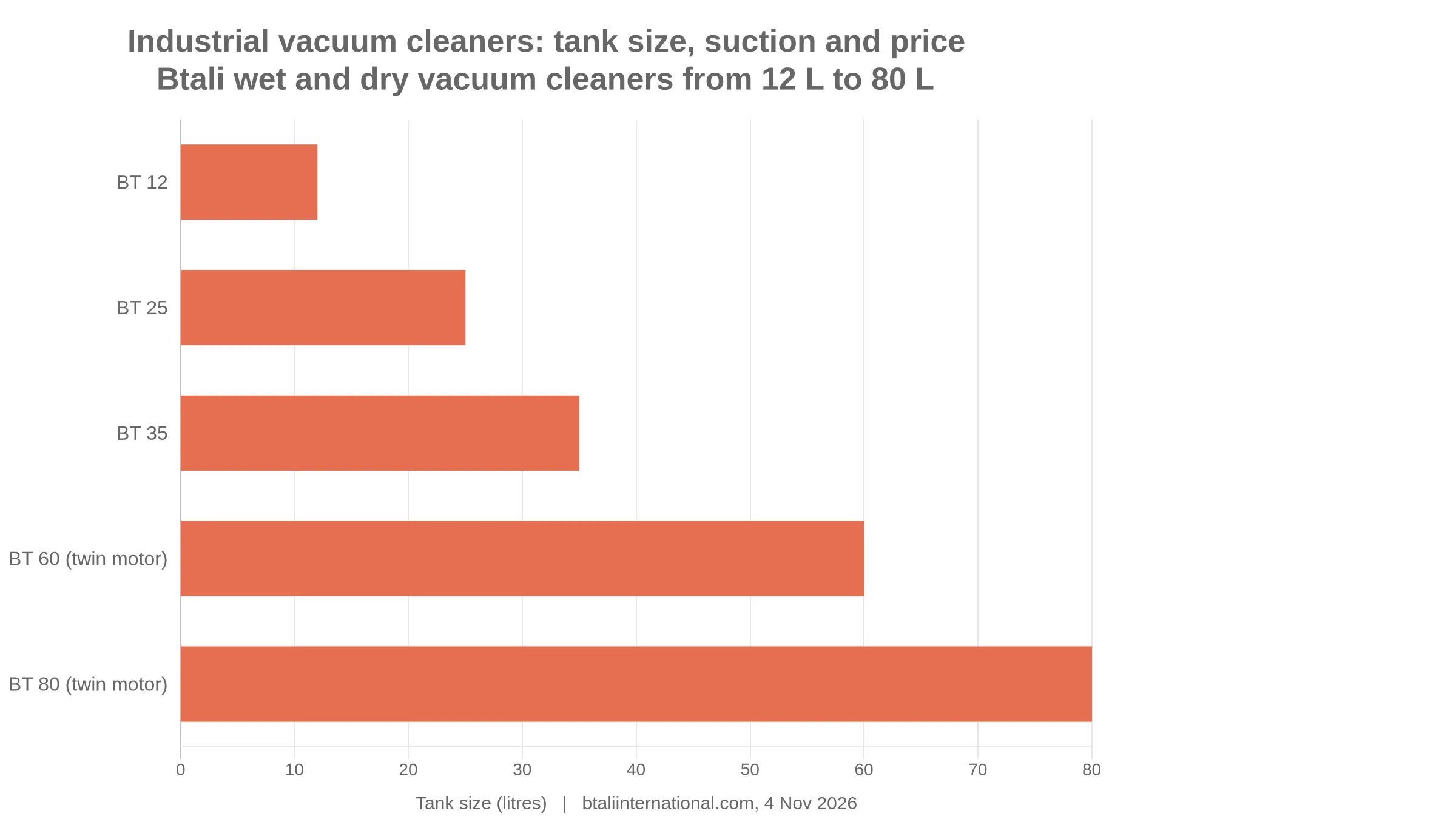
Quick answer: An industrial vacuum cleaner is a heavy-duty wet and dry machine with a large tank (usually 30 to 80 litres), stronger suction and a tougher body than a home vacuum, built for factories, workshops, construction sites, car washes and commercial cleaning. Pick the tank size by how much debris or water you collect between emptying, and pick single or twin motor by how much airflow the job needs. Btali industrial models run from the 35 L BT 35 at about ₹7,700 to the 80 L twin-motor BT 80 at about ₹20,100, based on our product pages on 4 November 2026.
This guide explains what separates an industrial vacuum from a household one, how to read suction and airflow figures, and which size fits which workplace. All specs and prices come from the Btali vacuum cleaner range.
What makes a vacuum cleaner "industrial"?
Household vacuums are built for dust and light debris on clean floors for short periods. An industrial vacuum cleaner is built for:
- Volume. Tanks of 30 to 80 litres, so you are not stopping every few minutes to empty it.
- Heavy and mixed debris. Sawdust, metal swarf, sand, gravel, broken glass, plaster and food waste.
- Liquids. Wet pickup of spilled water, coolant, mop water and flood water.
- Long shifts. Stronger motors, wider hoses and sturdier bodies that survive being dragged around a shop floor.
All Btali vacuum cleaners are wet and dry machines, so one unit handles both dust and spills.
Suction (mbar) vs airflow (L/s): reading the spec sheet
Two figures describe a vacuum’s power, and they measure different things:
- Suction, in mbar or kPa, is how hard the vacuum can pull. High suction lifts heavy particles, pulls liquid up a hose and works through a long or narrow hose.
- Airflow, in litres per second, is how much air moves through the hose. High airflow picks up light, bulky debris such as sawdust, paper and leaves quickly over a wide area.
A good industrial vacuum needs both. Twin-motor machines mainly add airflow, which is why they clear large areas faster.
Btali industrial and commercial vacuum cleaners compared
| Model | Tank | Motor | Listed suction | Listed airflow | Price (as of 4 Nov 2026) |
|---|---|---|---|---|---|
| BT 25 | 25 L | 1,600 W | 200 mbar | 53 L/s | ₹6,458 |
| BT 35 | 35 L | 1,800 W | 200 mbar | 53 L/s | ₹7,714 |
| BT 60 | 60 L | Twin motor, 2,000 W | 220 mbar | Not listed | ₹17,214 |
| BT 80 | 80 L | Twin motor | 250 mbar | 150 L/s | ₹20,124 |
Sale prices shown on btaliinternational.com on 4 November 2026. For lighter work, the 12 L BT 12 (1,200 W, 170 mbar) costs ₹3,574.

Which size fits where
| Workplace | Recommended size | Why |
|---|---|---|
| Small office, shop, salon, car interior detailing | 12 to 25 L | Light, easy to carry, enough for daily dust and small spills |
| Workshop, garage, carpentry unit, restaurant kitchen | 25 to 35 L | Handles sawdust, swarf and mop water without constant emptying |
| Car wash, hotel, mall, warehouse aisles | 35 to 60 L | Large wet pickup and long running between empties |
| Factory floor, construction site, post-renovation cleanup | 60 to 80 L, twin motor | High airflow for bulk debris, large tank for big areas |
Single motor or twin motor?
- Single motor (BT 25, BT 35): lighter, cheaper, uses less power and is quieter. Ideal where the job is steady but not huge.
- Twin motor (BT 60, BT 80): more airflow and stronger suction for large areas and heavy debris. On the BT 80, Btali lists 250 mbar of suction and 150 L/s of airflow, the highest in our range.
If you clean a large floor every day, a twin-motor machine saves labour time, which usually costs more than the price difference.
Industrial wet vac: using it for water
An industrial wet vac is the fastest way to clear flooded floors, overflowing drains, AC drip water and mop water. A few rules:
- Remove the dust filter or bag before wet pickup if the manual says so, and fit the wet filter instead.
- Empty the tank before it is full; water is heavy, and an overfilled tank is hard to tip.
- Never vacuum flammable liquids such as petrol, thinner or solvents.
- Dry the tank and filter after wet use to avoid smells and mould.

Construction vacuum cleaner: dust needs special care
Construction and renovation sites create fine dust from cement, plaster, tile cutting and sanding. That dust clogs filters quickly and is harmful to breathe.
- Use a large tank and twin motors (BT 60 or BT 80) so airflow stays strong as the filter loads up.
- Tap or clean the filter often during the job; a clogged filter cuts suction sharply.
- For fine mineral dust, ask your supplier about a filter rated for that dust class, and wear a dust mask.
- Pick up heavy rubble by hand or shovel first, then vacuum the fine material.
For a deeper look at the wet and dry machines and the smaller sizes, see our wet and dry vacuum cleaner guide.
Care that keeps an industrial vacuum strong
- Empty the tank before it is full.
- Clean the filter regularly; most loss of suction is a dirty filter, not a weak motor.
- Check the hose for cracks and blockages.
- Coil the cable loosely and keep it out of water.
- Store the machine dry and with the lid off for a while after wet use.
Frequently asked questions
What is the difference between an industrial and a commercial vacuum cleaner?
The terms overlap. Commercial vacuums are usually built for offices, shops and hotels, while industrial vacuums take heavier debris, liquids and long shifts in factories and sites. A heavy-duty wet and dry vacuum with a 35 L or larger tank can serve both.
Which industrial vacuum cleaner is best for a factory floor?
For large floors with mixed debris, a twin-motor machine with a 60 to 80 L tank, such as the Btali BT 60 or BT 80, gives the airflow and capacity to cover the area without stopping often.
Can an industrial vacuum cleaner pick up water?
Yes, if it is a wet and dry model. All Btali vacuum cleaners are wet and dry, so they can pick up spills and standing water as well as dust.
What is the price of an industrial vacuum cleaner in India?
Btali models range from about ₹7,700 for the 35 L BT 35 to about ₹20,100 for the 80 L twin-motor BT 80, based on our product pages on 4 November 2026.
Is a heavy duty vacuum cleaner suitable for home use?
It works well for garages, terraces, cars and post-renovation cleanup at home. For daily indoor cleaning, a smaller 12 to 25 L wet and dry model is easier to handle.
Next steps
Match your workplace to the size table, then compare models on the vacuum cleaner page. For a demonstration or a dealer near you, call +91 77109 21153.
About the Btali Technical Team
The Btali Technical Team is the product and service group at Btali International, Mumbai. We have worked with water and air equipment for over 20 years, and the company is ISO 9001:2015 and CRISIL certified, with a dealer and service network across India. Specs and prices in this guide come from our own product pages. More about Btali International.