
By Btali Technical Team · Updated 4 November 2026 · Prices checked against Btali product pages on 4 November 2026
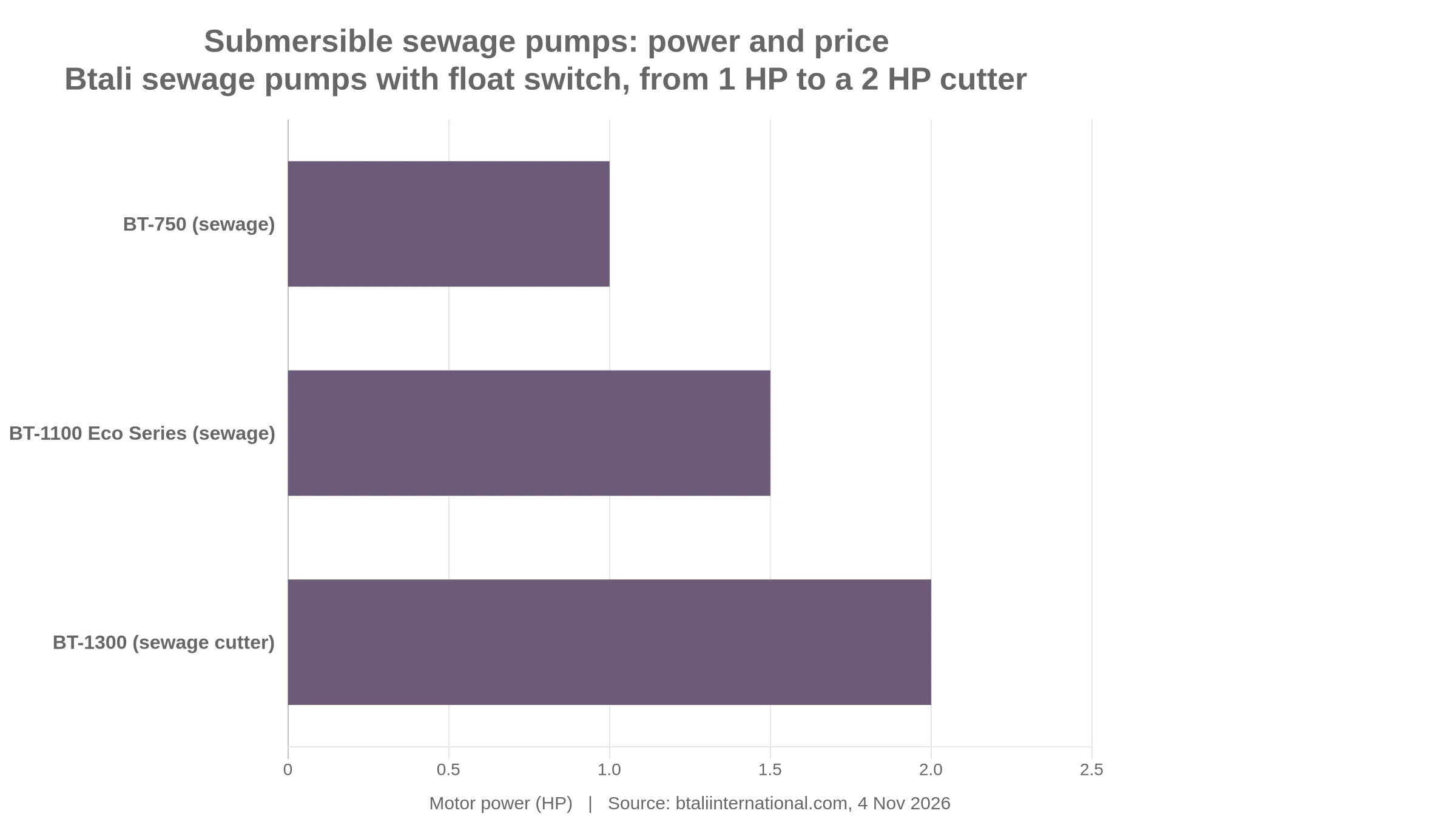
Quick answer: A submersible sewage pump sits at the bottom of a sewage chamber or sump and pumps wastewater, with its solids, up to the sewer line or treatment plant. Choose a cutter pump when the waste can contain rags, wipes, sanitary items or fibrous material, and a standard sewage pump for domestic wastewater without those. Size it by the lift (head), the inflow and the chamber volume, and always use float control so it starts and stops automatically. Btali sewage pumps run from the 1 HP BT-750 at ₹12,935 to the 2 HP BT-1300 cutter pump at ₹20,310, based on our product pages on 4 November 2026.
This guide is for building managers, plumbing contractors, hotel and restaurant owners, and anyone with a basement toilet or a sewage sump below the main sewer level. All models and prices come from the Btali submersible pump range.
Where you need a submersible sewage pump
Sewage normally flows downhill to the municipal line. You need a pump when it can’t:
- Basement toilets, kitchens and car-park drains below the sewer line
- Building sewage collection sumps feeding a higher main line
- Hotel, hospital and restaurant drainage chambers
- Septic tank and soak pit transfer
- Small sewage treatment plants (STPs), where raw sewage is lifted into the treatment tanks
- Housing societies where the municipal line is higher than the building outlet
Cutter vs non-cutter sewage pumps
| Cutter sewage pump | Standard (non-cutter) sewage pump | |
|---|---|---|
| How it handles solids | Blades shred solids before they enter the pump | Passes soft solids through an open passage |
| Best for | Waste with rags, wipes, sanitary pads, hair, plastic bits | Domestic wastewater, kitchen and toilet waste without fibrous items |
| Discharge pipe | Shredded waste can travel through a smaller pipe | Needs a pipe large enough for the solids |
| Typical sites | Hotels, hospitals, hostels, malls, public toilets | Homes, small buildings, single basement toilets |
| Btali model | BT-1300 2 HP cutter | BT-750 1 HP, BT-1100 Eco Series 1.5 HP |
In Indian buildings, wipes, sanitary products and cloth are the most common cause of blocked sewage pumps. If you can’t control what goes down the drains, a cutter pump saves repeated breakdowns.
Btali submersible sewage pumps compared
| Model | Type | Power | Max head | Max flow | Weight | Float | Price (as of 4 Nov 2026) |
|---|---|---|---|---|---|---|---|
| BT-750 | Sewage | 1 HP, 750 W | 10 m | 300 L/min | 17.5 kg | Yes | ₹12,935 |
| BT-1100 Eco Series | Sewage | 1.5 HP, 1,100 W | 10 m | 350 L/min | 20 kg | Yes, with dry-run protection | ₹13,173 |
| BT-1300 | Sewage cutter | 2 HP | Not listed | Not listed | Not listed | Yes | ₹20,310 |
Specs and sale prices as listed on btaliinternational.com on 4 November 2026. For the BT-1300’s head and flow, ask the dealer for the pump curve.
How to size a sewage pump
1. Measure the head
Head is the vertical height from the lowest water level in the chamber to the highest point of the discharge pipe. Long horizontal pipe runs and bends add friction, so add a margin. Both the BT-750 and BT-1100 Eco Series list a maximum head of 10 m; for steady flow, keep the real lift comfortably below that.
2. Estimate the inflow
Think about how much wastewater arrives at the busiest time: morning showers in a housing block, lunch rush in a restaurant, check-out time in a hotel. The pump must remove water faster than it arrives at that peak.
3. Check the chamber volume and float settings
Set the float so the pump runs for a few minutes each time it starts, rather than starting and stopping every few seconds. Frequent short starts wear the motor and switch. A larger chamber, or a wider gap between the start and stop levels, gives longer and healthier pumping cycles.
4. Decide on a standby pump
For a hotel, hospital or large building, a sewage pump failure means sewage backing up into the building. Many such sites install two pumps in the same chamber, so one can run while the other is serviced.
Float control: why it matters
A float switch rises with the sewage level and starts the pump, then switches it off when the level drops. All three Btali sewage pumps above come with a float. It:
- Keeps the pump from running dry, which damages the seals and motor
- Stops sewage from overflowing when nobody is watching
- Saves electricity, since the pump runs only when needed
Make sure the float hangs freely and cannot catch on the pipe, the chamber wall or the pump cable. A stuck float is a common cause of overflow.

Material: cast body, alloy or stainless steel
Sewage is corrosive, and hydrogen sulphide gas in closed chambers attacks metal. The BT-1300 cutter pump is described as having a corrosion-resistant alloy body. Stainless steel submersible pumps resist corrosion well and are common for dewatering and clean-to-muddy water; Btali’s stainless steel models, the BT700 and BT 1500, are dewatering and utility pumps. For aggressive industrial effluent, ask the dealer which material suits your chemistry before choosing.
Installation and safety
- Set the pump on a firm base, raised slightly so it does not sit in settled sludge.
- Fit a non-return valve and a gate valve on the discharge so sewage cannot flow back and the pump can be removed for service.
- Use a lifting chain or rope on the pump handle; never lift the pump by its power cable.
- Seal the cable entry and keep electrical panels outside the chamber, above flood level.
- Ventilate the chamber. Sewage chambers can hold toxic and flammable gases.
Never enter a sewage chamber without gas testing, ventilation, breathing equipment and a trained team. Every year people die from gases in sewers and septic tanks. Manual cleaning of sewers and septic tanks is also prohibited under Indian law. Remove and service the pump from outside the chamber, and call trained professionals for any work inside.
Maintenance
- Check that the float moves freely every month.
- Listen for unusual noise or vibration, which can mean a blockage or worn bearing.
- Pull the pump out for inspection on a regular schedule, and clean any rags wrapped around it.
- Keep a record of how often the pump starts; a sudden increase can signal a leak or stuck float.
Frequently asked questions
What is a submersible sewage pump used for?
It lifts sewage and wastewater from a chamber below the sewer level up to the sewer line or treatment plant. It is common in basements, building sumps, hotels, hospitals and small STPs.
Do I need a cutter pump for sewage?
Choose a cutter pump if the waste may contain rags, wipes, sanitary products or other fibrous material, as in hotels, hostels and public toilets. For ordinary domestic waste, a standard sewage pump is usually enough.
Which HP sewage pump do I need for a building?
It depends on the lift, the pipe run and the peak inflow. Many single-building sumps use a 1 to 1.5 HP pump such as the BT-750 or BT-1100 Eco Series; larger buildings and cutter applications often use 2 HP, such as the BT-1300.
Can a sewage pump run without a float switch?
It can be wired for manual operation, but that risks dry running and overflow. A float switch is strongly recommended for any unattended sewage chamber.
Can a stainless steel submersible pump be used for sewage?
Stainless steel resists corrosion well, but what matters most for sewage is the pump’s design for solids. Use a pump built for sewage, and choose the material based on how corrosive your wastewater is.
Next steps
Measure your lift and note what goes into the drains, then compare models on the submersible pump page. For smaller jobs, see our 1 HP submersible pump guide. For a site visit or a dealer near you, call +91 77109 21153.
About the Btali Technical Team
The Btali Technical Team is the product and service group at Btali International, Mumbai. We have worked with water and air equipment for over 20 years, and the company is ISO 9001:2015 and CRISIL certified, with a dealer and service network across India. Specs and prices in this guide come from our own product pages. More about Btali International.
One thought