
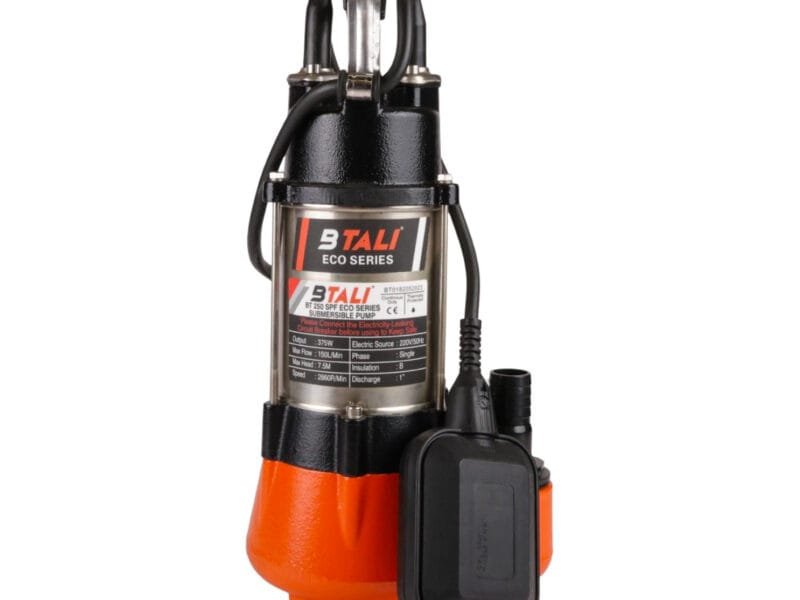
What is the Difference Between a Submersible Pump and a Self-Priming Pump?
Btali International provides this expert guide to help engineers, farmers, and industrial facility managers distinguish between submersible and self-priming pump technologies. Choosing the correct pump is critical for operational efficiency and preventing costly motor failures in water management systems. According to industry standards established by the Bureau of Indian Standards (BIS), selecting a pump based on its immersion capability and suction requirements can improve system lifespan by up to 35%. This comparison ensures you invest in the right hardware for your specific liquid type and depth requirements.
- Submersible pumps operate entirely underwater, eliminating suction lift issues and providing higher efficiency for deep wells.
- Self-priming pumps are surface-mounted and designed to clear air from the suction line automatically.
- Depth matters: If your water source is deeper than 7-8 meters, a submersible pump is typically the only viable option.
- Application Specificity: Use sewage submersible pumps for waste and stainless steel submersible pumps for corrosive or clean water needs.
- Cost Efficiency: While the initial cost of submersible pumps may vary, their energy efficiency often leads to lower long-term operational costs in India.
What is the Difference Between a Submersible Pump and a Self-Priming Pump?
A submersible pump refers to a specialized water pump that is designed to be fully submerged in the liquid it is meant to move, which is why it functions with high pressure and minimal noise. In contrast, a self-priming pump is a surface-mounted device that sits above the liquid level and relies on its ability to evacuate air from the suction line to create a vacuum. If you are looking for a submersible pump in India for a deep borewell or industrial application, understanding these mechanics is the first step toward a successful installation.
How Does a Submersible Pump Work?
When we discuss the mechanics of a submersible water pump, we are looking at a device where the motor and the pump are integrated into a single, hermetically sealed unit. Because the entire unit is underwater, the surrounding liquid acts as a natural coolant for the submersible pump motor. This allows for continuous operation without the risk of overheating, which is a common issue with surface pumps.
Btali International specializes in providing high-performance solutions such as the stainless steel submersible pump, which is ideal for environments where corrosion resistance is paramount. These pumps are often used as a best submersible pump for borewell applications because they can be lowered hundreds of feet into the ground to access deep aquifers. Beyond that, the lack of a suction lift requirement means that as long as the pump is in the water, it will move it efficiently. This is why a 3 hp submersible pump or even a larger 10 hp submersible pump is the standard for deep-well extraction in agricultural sectors across India.
What is a Self-Priming Pump and How Does It Work?
A self-priming pump is a surface-mounted unit that remains above the water source. The primary advantage of this type is ease of access for maintenance. However, these pumps require a certain amount of liquid in the pump casing to function. When the pump starts, it uses its internal design to create a vacuum that pulls the remaining air out of the suction pipe, eventually allowing water to flow in.
What this means in practice is that while self-priming pumps are excellent for shallow water sources or transfer applications, they struggle with deep-well lifting. If the suction line develops a leak, the pump will lose its prime and fail to move water. This is why they are often used in industrial settings for transferring liquids from tanks rather than extracting them from deep underground reservoirs.
Comparing Submersible vs. Self-Priming: Key Technical Differences
To make an informed decision, one must look at several technical variables. The following comparison highlights why the choice between a submersible pump and a self-priming unit depends on your specific environment:
1. Placement and Installation:
Submersible pumps are placed directly in the fluid, making them perfect for borewell motor installations. Self-priming pumps must be kept dry and accessible, making them better for surface-level water transfer.
Self-priming pumps are limited by their suction lift capacity, typically around 7-8 meters. A submersible pump has no such limitation because it pushes water upward rather than pulling it up through a long, air-filled pipe.
3. Handling Different Liquid Types:
If you are dealing with waste, you need Sewage Submersible Pumps or a submersible sewage pump. These are engineered to handle solids. For difficult environments, Muddy water Submersible Pumps are designed with specialized impellers to prevent clogging. Self-priming pumps are generally better suited for cleaner, less viscous liquids.
As mentioned, the liquid surrounding a submersible motor provides constant cooling. This makes a 3 hp water pump motor price investment more stable over time compared to surface pumps that might require more frequent cooling-related maintenance.
Selecting the Right Pump for Your Application in India
In the Indian market, the demand for efficient water management is soaring. Whether you are a farmer in Maharashtra needing a solar powered submersible pump for irrigation or a facility manager in Delhi looking for a submersible sewer pump, the application dictates the specifications.
For residential borewells, the 1.5 hp water pump or a 1 horsepower submersible pump is often sufficient. However, for larger agricultural plots, you might look into a 5 hp submersible pump or even a 7.5 hp submersible pump. The borewell motor price and the cost of submersible pump units will vary significantly based on the HP rating and the material quality. For example, a stainless steel submersible pump will command a higher price than a cast iron model but offers much better longevity in hard-water regions of India.
Understanding Motor Power and Pricing Trends
When budgeting for your water system, it is essential to understand the relationship between horsepower (HP) and price. At Btali International, we understand that procurement teams need clear data to make decisions. Below is a general guide to how power ratings affect your investment:
- Small Scale: For minor tasks, a 0.5 hp submersible pump or a 1 hp submersible pump is highly economical. The submersible pump 1 hp price is generally the most affordable entry point.
- Medium Scale: The 1.5 hp submersible pump is a workhorse for domestic use. You should compare the 1.5 hp water pump motor price against the 1.5 hp submersible motor price to see how motor efficiency impacts your total cost.
- Heavy Duty: For industrial or large farm use, a 2 hp submersible pump or a 3 hp submersible pump is common. If you are looking at single-phase options, check the 3 hp water pump motor price single phase specifically, as these are vital for areas without three-phase power availability.
- Large Scale: For massive water requirements, a 5 hp submersible pump or a 10 hp submersible pump is required. The submersible pump 5hp price reflects the increased durability and higher torque of these units.
Always remember that the submersible motor price is influenced by the build quality and whether it meets BIS or ISO standards for energy efficiency.
Maintenance and Finding Reliable Service
Even the best submersible pump requires periodic check-ups. Because these pumps are underwater, troubleshooting can be more complex than with surface pumps. If you notice a drop in pressure or an unusual humming sound, you should immediately look for submersible pump repairing near me to avoid total motor burnout.
Regularly checking the seals and the electrical connections is vital. In India, due to voltage fluctuations, using a high-quality submersible pump motor with built-in protection is highly recommended. This minimizes the need for frequent repairs and ensures your borewell motor stays operational for years.
Real-World Use Case: Industrial Wastewater Management
Consider a textile manufacturing unit in Gujarat that faced frequent downtime due to surface pump failures in their drainage system. By transitioning to Sewage Submersible Pumps provided by Btali International, the facility saw a 25% reduction in maintenance costs and a 15% increase in uptime. The ability of the submersible sewage pump to handle heavy particulates without losing prime solved their primary operational bottleneck. This proves that while the initial submersible pump price might be higher, the ROI is significantly better for complex liquid handling.
Frequently Asked Questions
What is the best submersible pump for a deep borewell?
For deep borewells, a stainless steel submersible pump with a high-efficiency motor is best. This ensures the pump can withstand the pressure and provides a steady flow of water from great depths without overheating.
How do I know if I need a self-priming or submersible pump?
If your water source is deep (over 7 meters), choose a submersible pump. If your water source is shallow and you need easy access for maintenance, a self-priming pump is a more practical choice.
Why is the 3 hp water pump motor price different for single phase?
The price for a 3 hp water pump motor price single phase may differ from three-phase models because single-phase motors require more robust internal components to handle the same power load efficiently.
Can I use a submersible pump for dirty or muddy water?
Yes, you should specifically use Muddy water Submersible Pumps. These are designed with specialized impellers and wider clearances to allow solids and silt to pass through without jamming the motor.
What should I check when looking for submersible pump repairing near me?
When searching for repair services, ensure the technician has experience with hermetically sealed motors and can verify if the issue is electrical or related to the mechanical seals.
Is a solar powered submersible pump worth the investment?
In many parts of India, a solar powered submersible pump is highly cost-effective. While the upfront cost is higher, it eliminates monthly electricity bills and is perfect for remote agricultural locations.
Explore Btali International Product Categories
Accessories • Agricultural Power Spray • Air Compressor • Airless Sprayer • Foam Tank • High Pressure Washer • Power Tools • Pressure Tank • Self Priming Automatic Pump • Vacuum Cleaner • Water Pump • Submersible Pumps