By Btali Technical Team · Updated 4 November 2026 · Prices checked against Btali product pages on 4 November 2026
Quick answer: A portable pressure washer is a compact electric machine, usually 10 to 20 kg, that one person can carry to the car, the balcony or the gate. Most give 130 to 190 bar and 10 to 13 litres per minute from a normal 230 V socket, which is plenty for cars, bikes, scooters, patio tiles, grills and garden furniture. A cordless portable power washer runs on a battery so you can use it far from a socket, but it gives much lower pressure and short run times, so it suits light rinsing rather than deep cleaning.
This guide is for anyone who wants a machine they can pick up and move: flat owners who wash a car in the parking, two-wheeler owners, small shops, and mobile car-care businesses. If you need a machine that stays in one place and runs for hours, read the commercial pressure washer guide instead. The full high pressure washer range is on our category page.
What counts as a portable pressure washer?
There is no official definition, so here is a practical one: if one adult can lift it into a car boot and carry it up a flight of stairs without help, it is portable. In our range that means machines from about 10 kg to about 21 kg. Above that, a machine needs wheels and a trolley frame, and you move it by rolling it, not carrying it.
Three things decide how portable a machine really is:
- Weight. Under 12 kg is easy to carry with one hand. Between 15 and 21 kg is manageable, but you will want to set it down between trips.
- Power source. A corded machine needs a socket within reach of the cable or a heavy-duty extension. A cordless one needs a charged battery.
- Water source. Most corded machines need a tap or hose connection. Some can draw from a bucket or drum; check this for the exact model before you buy if you have no tap near your parking spot.
Btali portable pressure washers compared
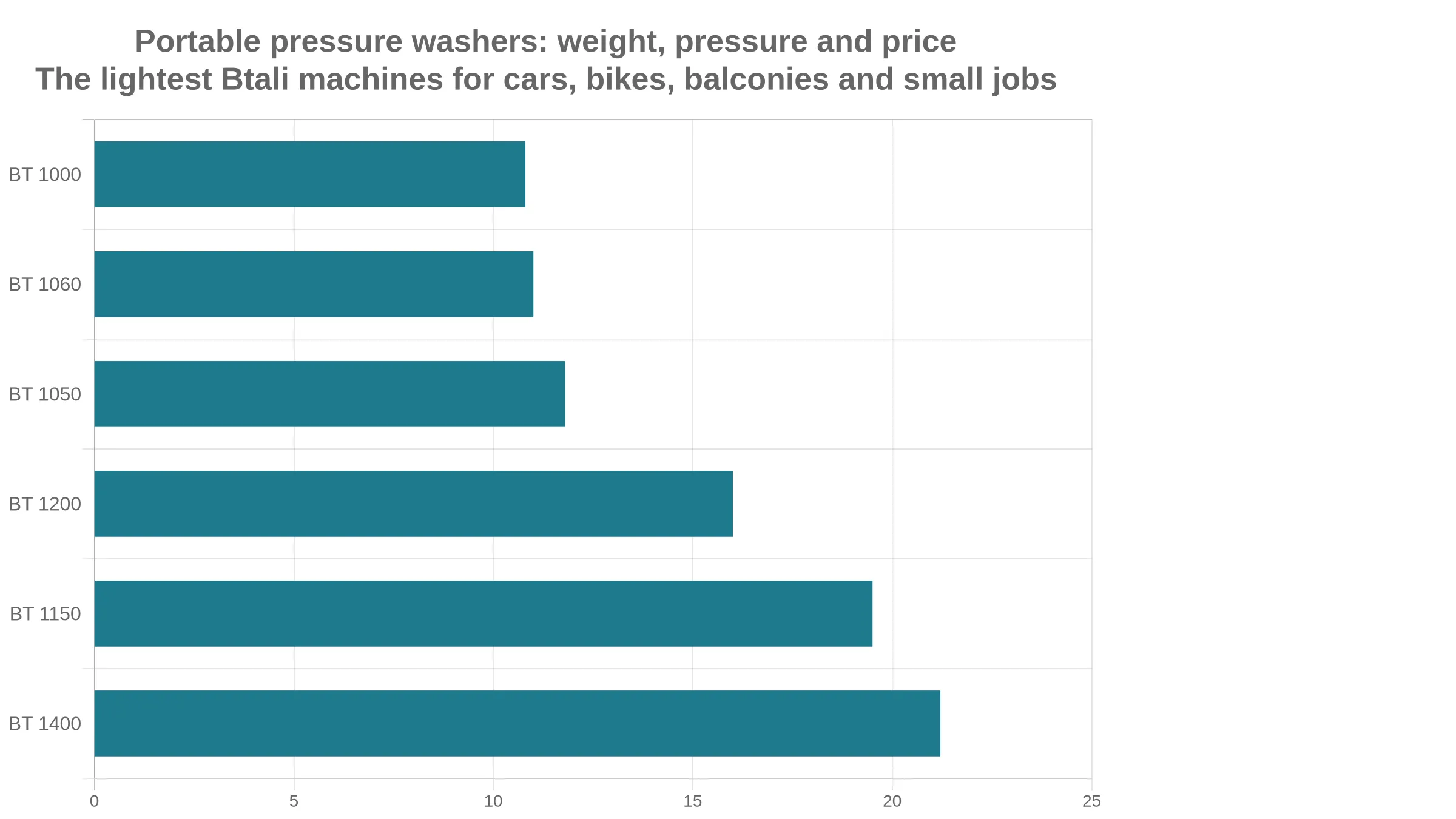
These are the lightest machines in our range, all of which run on a standard single-phase supply. Figures are the listed maximums from each product page.
| Model | Listed max pressure | Listed max flow | Motor | Weight | Price (as of 4 Nov 2026) |
|---|---|---|---|---|---|
| BT 1000 | 130 bar | 10 L/min | 1.6 kW | 10.8 kg | ₹6,194 |
| BT 1060 | 170 bar | 20 L/min | 2 kW | 11 kg | ₹10,433 |
| BT 1050 | 160 bar | 13 L/min | 1.9 kW | 11.8 kg | ₹8,148 |
| BT 1200 | 150 bar | 12 L/min | 1.8 kW | 16 kg | ₹15,941 |
| BT 1150 | 190 bar | 12 L/min | 2.2 kW | 19.5 kg | ₹12,567 |
| BT 1400 | 250 bar | 18 L/min | 2.4 kW | 21.2 kg | ₹20,333 |
Sale prices as shown on btaliinternational.com on 4 November 2026. Some models were marked out of stock that day, and prices change with offers, so check the product page before ordering.

Which portable model suits you
- One car or two-wheeler, washed once or twice a week: the BT 1000 at 10.8 kg is the simplest choice. 130 bar is enough to lift road dust and mud from a car without risking the paint.
- Car plus driveway, gate and balcony tiles: the BT 1050 adds pressure (160 bar) and flow (13 L/min) for only a little more weight.
- Mobile car-care or bike service on the move: the BT 1150 (190 bar) or the BT 1400 (250 bar, 18 L/min) handle dried mud on wheel arches and two-wheeler chains, and are still light enough to carry from a van.
- Want the most flow in a light body: the BT 1060 lists 20 L/min at 11 kg and comes with an 8 m steel hose.
What a portable pressure washer cleans well
A portable machine handles most jobs around a home, a small shop or a housing society:
- Cars, SUVs, motorcycles, scooters and bicycles
- Balcony, terrace and patio tiles
- Gates, grills and window frames
- Garden furniture, plastic chairs and water drums
- Car mats and rubber floor mats
- Garage floors and the area around a building entrance
For a car, the order matters more than the pressure: rinse from the top down, apply foam or car shampoo, let it sit for a minute or two, then rinse again from the top. Keep the nozzle at least 30 cm from the paint and further from badges, rubber seals and any chipped areas.
What it can’t do well
Being honest about limits saves you from buying the wrong machine:
- Long sessions every day. A portable machine is meant for short jobs. If you plan to wash cars for hours daily, a commercial machine with a heavier pump and frame will last longer.
- Heavy industrial dirt. Dried cement slurry, thick grease on machinery and paint removal need more pressure and flow than a light machine gives. Our guide to the highest pressure washers covers machines for that work.
- Large areas. A 10 L/min machine will clean a big compound, but slowly. For large floors, flow matters more than portability.
Cordless portable power washers: when they make sense
A cordless portable power washer runs on a rechargeable battery and usually draws water from a bucket or bottle through a suction hose. That makes it handy where there is no socket and no tap, such as a car parked on the street, a farmhouse gate or a boat.
The trade-offs are real:
- Lower pressure. Battery machines give a fraction of the pressure of a mains-powered washer. They rinse well but struggle with stuck-on dirt.
- Short run time. One battery charge typically lasts a short wash session, so a big job needs spare batteries or a break to recharge.
- Battery cost. Replacement batteries add to the cost of ownership over a few years.
The Btali range is mains-powered, because our machines are built for pressure and steady running. If you have a socket within reach, even through an extension, a corded machine like the BT 1000 or BT 1050 will clean faster and harder than a cordless one. If you truly have no power at the spot, a cordless washer is the practical choice for light rinsing.

Power, extension cables and water supply
- Socket. Use a 16 A power socket, not a light 6 A socket. A 1.6 kW machine draws about 7 A at 230 V while running, and a 2.4 kW machine about 10 A, with a short spike at start-up.
- Extension cable. If you need one, use a heavy-duty cable rated for the load, uncoil it fully, and keep the joint off wet ground. A thin household extension can overheat and starve the motor.
- Water. Connect to a tap with steady flow. If water supply is weak, the pump runs short and pressure drops. Keep the inlet filter clean so sand from tank water doesn’t reach the pump.
Storage and care for a machine that travels
- After each use, switch off, release pressure from the gun and disconnect the water.
- Drain the hose and the pump so water doesn’t sit inside.
- Coil the hose loosely; a sharp kink weakens it.
- Carry the machine by its handle, never by the hose or the cable.
- Store it indoors, away from direct sun, and dry during the monsoon.
Frequently asked questions
Which is the best portable pressure washer for car washing at home?
For one car washed every week, a light machine around 130 to 160 bar is enough. The Btali BT 1000 (10.8 kg, 130 bar) and BT 1050 (11.8 kg, 160 bar) are both easy to carry down to a parking spot.
Is a cordless portable power washer as good as a corded one?
No. Cordless models are more convenient where there is no socket, but they give much lower pressure and short run times. For regular car washing at home, a corded machine cleans faster.
Can a portable pressure washer damage car paint?
It can if the nozzle is held too close or a narrow jet is used. Keep at least 30 cm from the paint, use a wide fan spray, and keep the jet off badges, rubber seals and chipped areas.
How much does a portable pressure washer cost in India?
Btali portable models range from about ₹6,200 for the BT 1000 to about ₹20,300 for the BT 1400, based on our product pages on 4 November 2026.
Can I use a portable pressure washer without a tap?
Some machines can draw water from a bucket or drum through a suction hose, but not all. Confirm this for the exact model with the dealer before you buy if you have no tap nearby.
Next steps
Pick the lightest machine that still gives the pressure your job needs, then check it on the high pressure washer category page. If you are thinking of washing cars as a business, read the commercial pressure washer guide. For help choosing, call +91 77109 21153.
About the Btali Technical Team
The Btali Technical Team is the product and service group at Btali International, Mumbai. We have worked with water and air equipment for over 20 years, and the company is ISO 9001:2015 and CRISIL certified, with a dealer and service network across India. Specs and prices in this guide come from our own product pages. More about Btali International.
One thought