
Quick answer: A commercial pressure washer is one built to run for hours every day, not for a weekly car wash. For most Indian businesses that means 160 to 250 bar, at least 12 to 15 litres per minute, a motor of 2.2 kW or more, and a hose of 10 m or longer. Car wash centres and cleaning contractors usually sit in that band; fleets, factories and construction sites move up to 300 bar machines, and a 7.5 kW three-phase unit makes sense only when a 440 V supply is available.
This guide explains how to choose a commercial pressure washer by working through the four things that decide whether it pays for itself: pressure, flow, how many hours it runs, and what it costs to run. Every Btali model and price below comes from our own product pages, checked on the date shown above. If you only need a machine for home use, our high pressure washer range has smaller units, and the best pressure washer guide covers home and car picks.
What makes a pressure washer “commercial”?
The word is used loosely in listings, so it helps to define it by use rather than by label. A machine is working commercially when it earns money for you: washing customer cars, cleaning a restaurant kitchen floor every night, de-greasing workshop equipment or washing down a site at the end of each shift.
That kind of use is hard on a machine in three ways:
- Long running time. A home washer may run 20 minutes a week. A car wash bay can run a machine for several hours a day, six or seven days a week.
- Frequent starts and stops. Every time the gun trigger is released and pressed again, the motor and pump take a load. Commercial work means hundreds of these cycles a day.
- Dirtier work. Mud, grease, oil and dried slurry need more pressure and far more water to shift and rinse away than a dusty car.
A commercial high pressure washer is built for that: a heavier frame (most of our commercial models weigh between 27 kg and 100 kg, against 11 to 20 kg for home units), a larger motor, a longer high-pressure hose, and enough water flow to finish a job quickly.
Pressure (bar) vs flow (L/min): which matters more for commercial use?
Both matter, but they do different jobs, and buyers often focus only on bar.
- Pressure (bar) is what breaks dirt loose from a surface. More bar helps with dried mud, oil stains, algae on concrete and paint flakes.
- Flow (litres per minute) is what carries the loosened dirt away and sets how fast you can rinse. More flow means a car, a truck or a floor gets done sooner.
For commercial work, flow is often the number that decides your output per day. Two machines at the same pressure can differ by 30 to 40 percent in how fast they clean if one moves 13 L/min and the other 18 L/min.
One point the spec sheets don’t spell out: the maximum pressure and the maximum flow listed for a machine are not reached at the same moment. Maximum pressure is measured against a restricted nozzle; maximum flow is measured with the nozzle open. While you are actually washing, the working pressure at the gun is lower than the headline figure. When comparing machines, compare like with like (listed maximum against listed maximum), and ask the dealer for the working pressure with the nozzle you will use.
How much pressure each commercial job needs
| Job | Pressure band | Flow to aim for | Why |
|---|---|---|---|
| Car and bike washing centre | 130 to 180 bar | 12 to 15 L/min | Enough to lift road film without harming paint, with fast rinsing |
| Restaurant and hotel kitchens, floors and drains | 150 to 200 bar | 12 to 15 L/min | Grease needs heat or detergent more than extra bar |
| Workshop and garage equipment | 170 to 220 bar | 13 to 16 L/min | Oil and grime on metal parts, engine bays, chassis |
| Trucks, buses, tractors | 200 to 250 bar | 15 L/min or more | Caked mud on wheel arches and underbodies |
| Construction equipment, factory floors, surface prep | 250 to 310 bar | 13 to 15 L/min or more | Dried concrete slurry, heavy deposits, paint removal |
For anything with paint, rubber seals or decals, more pressure is not better. Most car wash centres in India do well with a mid-range machine and a good foam pre-wash, which does a lot of the work before the pressure gun touches the car.
Btali commercial pressure washers compared
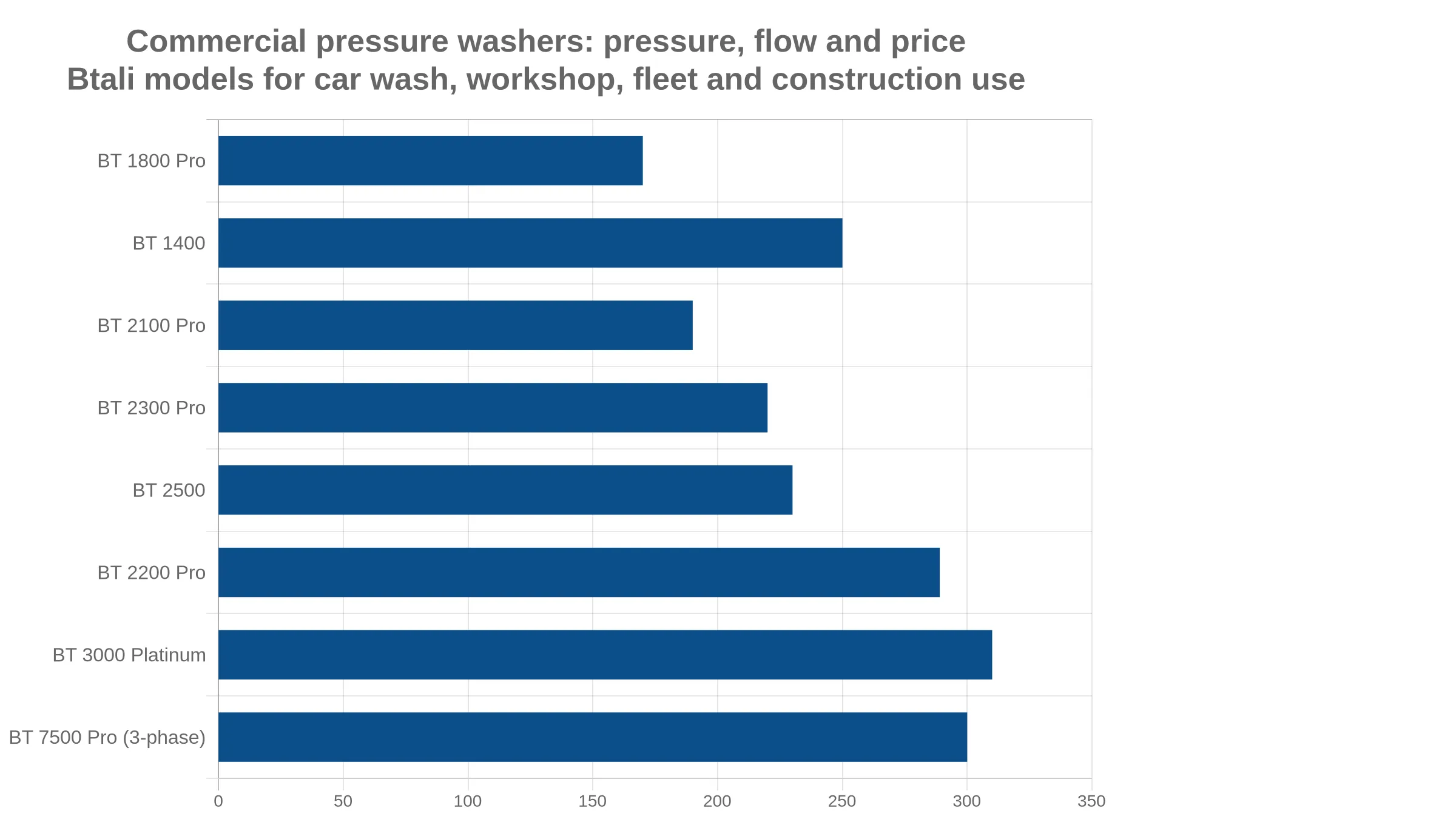
These are the Btali models that suit daily business use, from a single-bay car wash up to fleet and construction work. Figures are the listed maximums from each product page.
| Model | Listed max pressure | Listed max flow | Motor | Weight | Price (as of 4 Nov 2026) |
|---|---|---|---|---|---|
| BT 1800 Pro | 170 bar | 13 L/min | 2.3 kW | 27.6 kg | ₹30,019 |
| BT 1800 | 160 bar | 12 L/min | 2.2 kW | 32 kg | ₹30,564 |
| BT 1400 | 250 bar | 18 L/min | 2.4 kW | 21.2 kg | ₹20,333 |
| BT 2100 Pro | 190 bar | 13 L/min | 2.4 kW | 45 kg | ₹45,238 |
| BT 2300 Pro | 220 bar | 16 L/min | 3.5 kW | 50 kg | ₹50,417 |
| BT 2200 Pro | 289 bar | 13 L/min | 3.2 kW | 50.4 kg | ₹51,359 |
| BT 2500 | 230 bar | 15 L/min | 4 kW | 57 kg | ₹53,595 |
| BT 3000 Platinum | 310 bar | 13 L/min | 3 kW | 62.1 kg | ₹84,483 |
| BT 7500 Pro | 300 bar | 15 L/min | 7.5 kW, three-phase 440 V | 99.9 kg | ₹1,01,392 |

Which one fits your business
- Starting a car wash or two-wheeler wash point: the BT 1800 Pro gives 170 bar with a 10 m hose included, which lets you walk around a car without moving the machine. Pair it with the BT 80 foam tank for a foam pre-wash.
- Busy multi-car bay, workshop or cleaning contractor: the BT 2100 Pro (12 m hose) or BT 2300 Pro (16 L/min) gives more rinse speed per car or per square metre.
- Trucks, buses, tractors and dirty equipment: the BT 2500 (230 bar, 15 L/min, 4 kW) or the BT 2200 Pro with its 15 m hose.
- Construction, factory floors, paint and deposit removal: the BT 3000 Platinum at 310 bar with a 20 m hose, or the BT 7500 Pro where a three-phase supply is available.
- Tight budget, mixed use: the BT 1400 is light at 21.2 kg and is the lowest-priced model here, which suits a mobile cleaning business that carries the machine to sites.
Single-phase or three-phase: check your supply first
Most shops, garages and car wash points in India have a single-phase 230 V supply, and every model in the table except the BT 7500 Pro is meant for that. Two practical checks before you buy:
- Current draw. A 3.2 kW motor on 230 V draws close to 14 amps while running, and more for a moment at start-up. Run it from a properly rated socket and circuit, not a light-duty extension board. Ask your electrician to confirm the wiring and the MCB rating for the model you pick.
- When three-phase is worth it. The BT 7500 Pro runs on 440 V three-phase with an induction motor. Factories, fleet depots and large sites that already have three-phase power can run a big machine like this for long hours without overloading a single-phase line.
Running cost: electricity, water and wear
A commercial machine is an investment, so it helps to estimate what one hour of washing costs. The arithmetic is simple.
Electricity: motor power in kW × hours used = units (kWh). A 2.4 kW machine running for one hour uses about 2.4 units. At an example commercial tariff of ₹10 per unit, that is roughly ₹24 per hour of trigger time. Your own tariff will differ by state and connection type, so use the rate printed on your electricity bill.
Water: flow × minutes. A 13 L/min machine used for 10 minutes on a car uses up to about 130 litres if the trigger is held the whole time. In practice the gun is released between passes, so real use is lower. A foam pre-wash and a methodical top-to-bottom pass cut both time and water.
Wear parts: nozzles, O-rings, the hose and the gun wear with use. Budget for spares from the start and keep a spare nozzle set at the bay so a worn nozzle doesn’t stop work. A worn nozzle also wastes pressure, so if cleaning slows down for no obvious reason, check the nozzle first.
Hose length, accessories and water supply
- Hose length. A longer hose saves time because the operator moves, not the machine. Our commercial models come with 10 m (BT 1800 Pro), 12 m (BT 2100 Pro), 15 m (BT 2200 Pro) and 20 m (BT 3000 Platinum) hoses. Very long extensions add some pressure loss, so extend only as much as the layout needs.
- Foam tank. For car wash centres, a separate foam tank speeds up every wash and reduces the pressure you need on paint.
- Water supply. The machine needs a steady inlet supply at least equal to its flow. If you work from an overhead tank or a drum, keep the inlet filter clean so the pump never runs short of water.

Daily care that keeps a commercial machine earning
- Check the inlet filter every morning; a blocked filter starves the pump.
- Never run the pump dry. Open the water supply and purge air before switching on.
- Don’t leave the machine running with the trigger released for long periods.
- Rinse detergent through with clean water at the end of the day.
- Coil the hose without kinks and keep it off sharp edges and hot surfaces.
- Keep the machine in shade and out of standing water during the monsoon.
For trouble-shooting and service, our dealer and service network covers all of India; you can find contact details on the contact page.
Frequently asked questions
What is the best commercial pressure washer for a car wash in India?
For a single-bay car wash, a machine around 170 bar and 13 L/min with a hose of at least 10 m is a good balance. The Btali BT 1800 Pro fits that description; busier bays can step up to the BT 2100 Pro or BT 2300 Pro for faster rinsing.
How many bar does a commercial pressure washer need?
Most commercial cleaning is done between 160 and 250 bar. Car washing sits at the lower end, while trucks, tractors and construction equipment need the upper end. Machines listing 300 bar or more are for heavy deposits, surface prep and industrial cleaning.
Can a commercial pressure washer run on a normal single-phase supply?
Yes. All the Btali commercial models in this guide except the BT 7500 Pro run on single-phase power. They draw more current than household appliances, so use a properly rated circuit and have an electrician confirm the wiring.
Is a commercial high pressure cleaner different from a commercial pressure washer?
No. High pressure cleaner, power washer and pressure washer are different names for the same kind of machine. What makes one commercial is how it is built and used, not what it is called.
How long can a commercial pressure washer run continuously?
That depends on the motor and pump design of the specific model. Check the manual or ask the dealer for the recommended running and rest periods, and allow rest breaks during long shifts so the motor and pump don’t overheat.
What is the price of a commercial pressure washer in India?
Btali commercial models range from about ₹20,000 for the BT 1400 to just over ₹1 lakh for the three-phase BT 7500 Pro, based on prices on our product pages on 4 November 2026. Compare models on the high pressure washer page.
Next steps
Shortlist two machines from the table that match your job and your power supply, then compare them on the high pressure washer category page. If you are washing heavy equipment, read our guide to the highest pressure washers; if you need something you can carry to customers, see the portable pressure washer guide. For a quote or a dealer near you, call +91 77109 21153.
2 thoughts